24/7 Emergency Tree Removal
Rapid Dispatch Crane & Rigging Extractions for Storm-Damaged, Fallen & Uprooted Trees
- 1. Executive Overview & Critical Risk Triage
- 2. Comprehensive Risk Triage & Structural Emergency Response
- 3. Primary Indicators Requiring Immediate Emergency Tree Extraction
- 4. Step-by-Step Technical Execution & ISA Certified Arborist Standards
- 5. Industrial Machinery & Heavy Equipment Mobilization
- 6. Homeowners Insurance Claims & Adjuster Billing Guide
- 7. Frequently Asked Questions
When severe thunderstorms, gale-force wind squalls, or heavy winter ice storms bring down massive trees onto residential homes, commercial properties, or access driveways, immediate professional action is paramount. Emergency tree removal is a specialized high-risk operation requiring heavy crane machinery, complex friction rigging systems, and ISA-certified arborist supervision to extract multi-ton fallen trunks safely without inflicting secondary structural destruction upon your home.
Comprehensive Risk Triage & Structural Emergency Response
Fallen or uprooted trees exert massive dynamic loads upon roof trusses, load-bearing walls, and utility clear zones. When a mature Oak, Pine, or Maple suffers structural failure during severe weather, thousands of pounds of dead weight rest precariously over living spaces. Attempting non-professional removal or cutting under tension can cause violent trunk kickback, sudden roof collapses, or severe personal injury. Emergency arborist crews conduct immediate structural load assessments to stabilize the hazard before initiating heavy crane lifts.
Primary Indicators Requiring Immediate Emergency Tree Extraction
- Fallen Tree Structure Impact: Mature trees or heavy limbs actively crushing house roofs, attached garages, carports, or outdoor structures.
- Complete Root Ball Failure: Uprooted root plates lifting lawn turf, concrete driveways, sidewalk slabs, or foundation footings.
- Suspended Canopy Hazards: Broken limbs ('hangers' or 'widowmakers') trapped high in adjacent canopies threatening living areas.
- Driveway & Access Blockage: Fallen trunks obstructing primary residential driveways, private access roads, or emergency vehicle routes.
- Utility Clear-Zone Encroachment: Trees leaning perilously toward overhead electrical service drops or main municipal power corridors.
Step-by-Step Technical Execution & ISA Certified Arborist Standards
Our network of emergency tree removal specialists strictly adheres to ANSI A300 arborist standards and OSHA 1910.269 tree care safety regulations during every emergency dispatch:
Immediate 24/7 Hazard Assessment
Dispatch operators log exact site coordinates, structural damage severity, tree species, and overhead utility clearance to mobilize the appropriate heavy machinery unit.
Heavy Crane Rigging & Sling Attachment
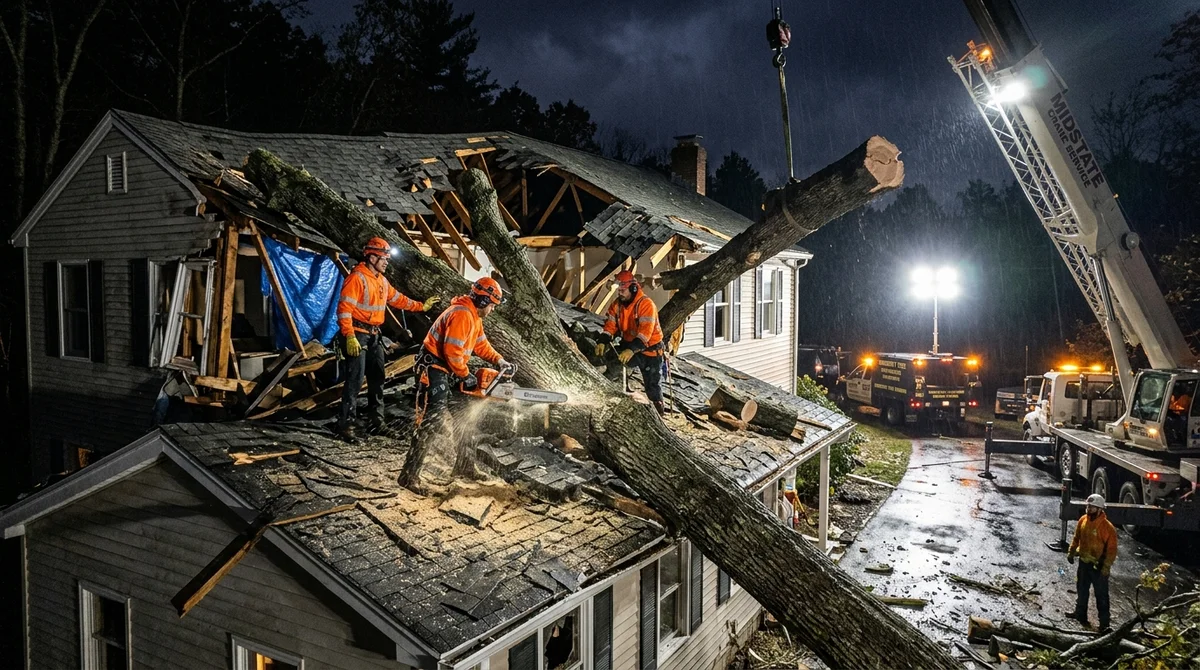
Certified arborist climbers ascend the hazard tree or utilize aerial bucket booms to attach heavy-duty synthetic slings to the fallen trunk, counterbalancing weight prior to cutting.
Controlled Sectional Tension Relieving
Arborists make precision relief cuts using high-capacity chainsaws while crane operators maintain steady upward tension, lifting multi-ton trunk sections clear of structures.
Ground Chipping & Emergency Roof Tarping
Brush and limbs are immediately processed through industrial wood chippers, while emergency crews secure waterproof tarps over roof openings to halt water intrusion.
Industrial Machinery & Heavy Equipment Mobilization
Standard landscaping tools are incapable of resolving major storm tree disasters. Emergency response teams deploy heavy commercial machinery engineered for extreme load capacities:
- 100-Ton Hydraulic All-Terrain Cranes: Designed to hoist 15,000+ lb fallen trunks cleanly over residential roofs and swimming pools without ground disturbance.
- 75ft High-Reach Aerial Bucket Trucks: Hydraulic boom platforms providing safe access to elevated hazard branches near power lines.
- 18-Inch Industrial Brush Chippers: High-torque diesel wood chippers that process dense hardwood limbs into clean wood mulch in seconds.
- Heavy Self-Propelled Grapple Loaders: Articulating hydraulic arms that scoop massive log sections into high-side haul trailers.
Homeowners Insurance Claims & Adjuster Billing Guide
In most storm damage events, standard homeowners insurance policies cover tree removal costs when a tree strikes a covered structure (house, garage, fence) or blocks primary driveway access. Professional emergency crews work directly with major insurance carriers to streamline your claim:
- Direct Adjuster Billing Support: Comprehensive itemized invoices formatted to meet insurance industry guidelines.
- Digital Photo & Video Documentation: Before, during, and after high-resolution photo logs capturing structural damage and hazard mitigation.
- Written Cause of Loss Reports: Certified arborist statements documenting storm wind gusts, lightning strikes, or ice accumulation as the primary cause.
- Zero Out-of-Pocket Options: Supporting direct billing to your carrier so emergency hazard mitigation begins immediately.
Frequently Asked Questions About 24/7 Emergency Tree Removal
Will homeowners insurance cover emergency tree removal?
Yes. Standard homeowners insurance policies typically cover emergency tree extraction when a storm causes a tree or large branch to fall and damage a covered structure (home, garage, shed, fence) or block driveway access.
How fast can an emergency tree crew respond?
Emergency dispatch operators operate 24 hours a day, 7 days a week. Heavy equipment and arborist crews are mobilized immediately, typically arriving on-site within 1 to 3 hours depending on severe weather road conditions.
What should I do while waiting for the emergency tree crew to arrive?
Evacuate rooms directly beneath fallen trees or heavy structural impact zones. Stay completely clear of fallen utility lines, turn off electrical main breakers if water leakage occurs, and refrain from attempting to cut tensioned trunks yourself.
Can heavy cranes operate in residential yards without damaging driveways?
Yes. Professional crane operators utilize heavy-duty outrigger pads and turf protection mats to distribute vehicle weight evenly, protecting asphalt driveways and lawns during heavy extractions.