Hazardous Tree Removal
Controlled Sectional Dismantling & Takedown of Dead, Diseased & Dangerous Trees
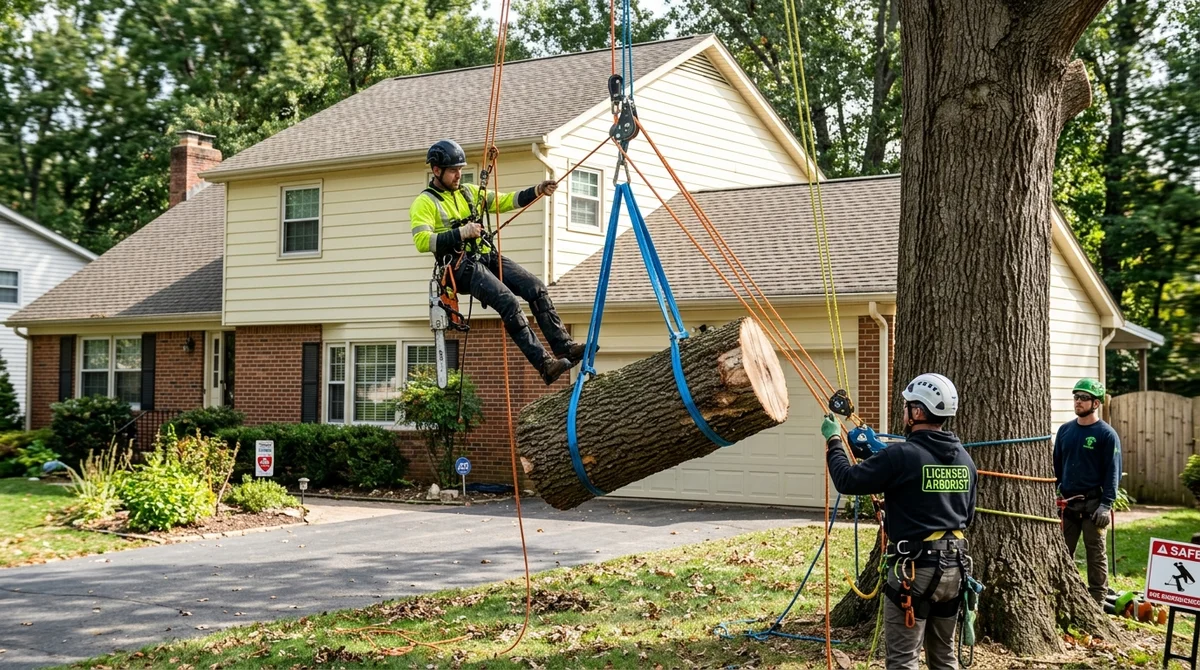
- 1. Executive Overview & Critical Risk Triage
- 2. Comprehensive Tree Health Assessment & Decay Diagnostics
- 3. Primary Signs Your Tree Requires Professional Hazardous Removal
- 4. Controlled Sectional Dismantling & Rigging Workflow
- 5. Heavy Equipment Utilized for Confined-Space Tree Extractions
- 6. Preventative Tree Removal vs. Insurance Coverage
- 7. Frequently Asked Questions
Trees suffering from advanced internal trunk rot, hollow heartwood, structural fungal infections, or severe structural leaning pose an ever-increasing hazard to nearby homes, utility lines, and family safety. Controlled hazardous tree removal is a precise engineering discipline involving sectional piece-by-piece lowering using high-tensile arborist ropes and friction brakes to dismantle dangerous trees safely within tight suburban confines.
Comprehensive Tree Health Assessment & Decay Diagnostics
Determining when a leaning or aging tree transitions from a shade asset to a catastrophic hazard requires expert arborist evaluation. Internal decay often hollows out the structural heartwood of mature Oaks and Maples while leaving outer bark looking normal. Certified arborists evaluate canopy dieback, trunk cavities, root plate movement, and fungal fruiting bodies to diagnose structural compromise before sudden collapse occurs during seasonal storms.
Primary Signs Your Tree Requires Professional Hazardous Removal
- Extensive Trunk Cavities & Hollows: Large open hollows or soft, decaying wood occupying over 30% of the main trunk diameter.
- Severe Unbalanced Leaning: Sudden or progressive leaning accompanied by soil mounding or root lifting at the tree base.
- Fungal Conks & Mushroom Clusters: Bracket fungi, conks, or mushroom growth sprouting along main trunk crotches or root flare zones.
- Co-Dominant V-Crotch Split: Deep vertical splits extending down the junction between two main competing trunk stems.
- Significant Canopy Dieback: More than 50% deadwood, missing foliage, or brittle bark shedding from primary scaffold limbs.
Controlled Sectional Dismantling & Rigging Workflow
When space constraints prevent directional felling from the ground, arborist crews execute controlled sectional takedowns following rigid ISA protocol:
Site Drop Zone Preparation
Ground crews establish safety perimeters, clear lawn furniture, and lay heavy rubber turf mats to protect underlying grass and irrigation heads.
Friction Rigging Device Mounting
Climbers secure high-tensile arborist lowering ropes through top-canopy pulleys and anchor friction rigging brakes at the tree base.
Systematic Branch Sectioning
Limbs are cut starting from lower canopy scaffold branches working upward, with ground crews controlling lowering speeds via friction brakes.
Trunk Segment Takedown & Cleanup
The main vertical trunk is sectioned into manageable wood blocks, lowered safely, and loaded onto haul trailers for complete site clearing.
Heavy Equipment Utilized for Confined-Space Tree Extractions
Handling large hazardous trees near glass windows, swimming pools, and power lines requires specialized gear:
- Friction lowering Brakes (Port-a-Wrap): Allows ground operators to hold multi-ton wood sections with minimal hand force.
- High-Reach Aerial Boom Trucks: Enables arborists to cut dead branches safely without placing body weight on brittle trunks.
- Heavy-Duty Log Haul Trailers: High-capacity trailers that transport massive timber logs off-site for timber processing.
- Turf Protection Ground Mats: Interlocking composite mats that shield residential lawns from heavy equipment tire tracks.
Preventative Tree Removal vs. Insurance Coverage
Homeowners often inquire whether insurance covers preventative removal of standing dead trees. While insurance carriers generally consider dead tree removal standard property maintenance, removing a hazardous tree preventatively is vastly cheaper than paying deductible costs and repairing severe roof damage after a storm failure.
Frequently Asked Questions About Hazardous Tree Removal
How much space is needed for hazardous tree removal?
Arborist crews specialize in tight-space removals. Using sectional rigging or crane hoists, trees can be removed safely in yards with as little as 3 feet of clearance from structures.
Can a hollow tree be saved instead of removed?
It depends on the remaining healthy shell thickness. If sound wood covers less than 30% of the trunk radius, removal is typically recommended to prevent sudden windstorm failure.
Do I need a municipal permit for tree removal?
Many municipalities require permits for removing trees above a certain trunk diameter or within historic/environmental zones. Professional arborist companies assist in permit filings.
What happens to the wood after tree removal?
All limbs and small branches are chipped into clean mulch. Large trunk logs are hauled away for timber processing, or sectioned into firewood upon homeowner request.