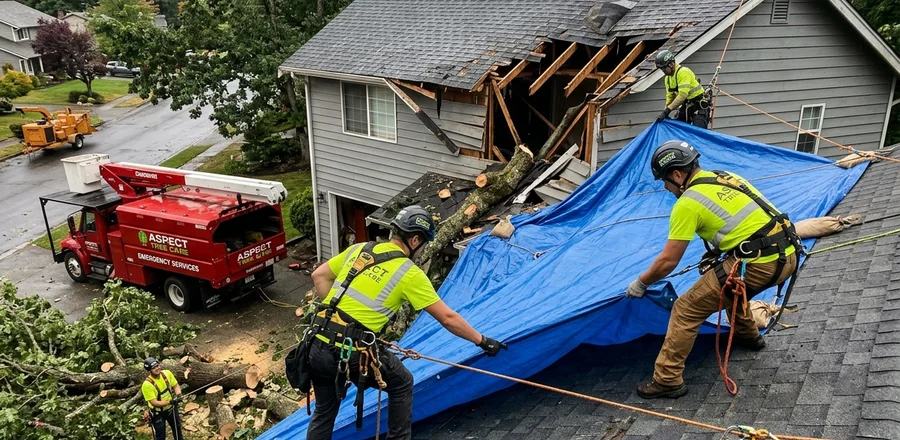
In cities known for aggressive tree protection laws—such as Atlanta, Austin, Charlotte, Seattle, and Portland—removing a protected heritage tree without a city permit can result in catastrophic code enforcement fines ranging from $1,000 to $20,000+ per tree. But what happens when severe storm downbursts crush an 80-year-old oak across your roof at 2:00 AM? Do you have to wait three weeks for a municipal arborist inspection before removing it? The answer is an emphatic NO, thanks to the universal Emergency Hazard Exemption.
1. What Legally Qualifies as an "Emergency Hazard"?
Municipal forestry codes strictly define an emergency tree condition:
- Structural Impact: The tree or major limb is actively resting on, puncturing, or compromising a primary residence, attached garage, or occupied commercial building.
- Active Root Plate Failure: The soil on one side of the tree is actively heaving, cracking, or lifting, indicating that anchorage has failed and total collapse is imminent within hours.
- Utility Encroachment: The tree has fallen into or is leaning directly across high-voltage electrical distribution lines or blocking emergency vehicle ingress routes.
- Split Main Trunk: Codominant stems have cracked open, exposing a fresh heartwood tear that cannot be stabilized with cables.
What does NOT qualify: A tree that is dead but upright and has shown no recent movement, or a tree you simply wish to remove before a storm arrives next month. Non-emergency removals must proceed through the standard municipal permit review process.
2. Step-by-Step Retroactive Permit Protocol
To avoid code enforcement citations and mandatory replacement tree fines following an emergency felling, execute this 4-step compliance protocol:
Take Detailed Photo Evidence BEFORE the First Cut
Municipal urban foresters require conclusive proof that an emergency existed. Take wide-angle shots showing the tree on the structure and close-up photos of the split crotch or heaved root plate. If you cut the tree down without pre-removal photos, the city can cite you for illegal felling.
Fell the Tree to a Safe Height (Make Safe)
Emergency crews should cut the fallen tree clear of the dwelling and lower limbs to the ground. If the base trunk does not pose further hazard, leave the stump intact until the city arborist confirms the condition.
Obtain a Written Statement from an ISA-Certified Arborist
Request that your emergency tree service provide a signed letter stating that the tree constituted an "imminent threat to life and property under municipal code section [X]" and required instantaneous felling.
Submit the Retroactive Notification Within 48 Hours to 14 Days
Email your city or county Urban Forestry Division or Department of Planning. Submit the application marked "Emergency Retroactive Removal Notification" along with your photos and arborist statement.
3. The "Parkway / Tree Lawn" Exemption: Free City Tree Removal
Before spending thousands of dollars on a private tree service, check the exact location of the tree trunk:
- If the tree is rooted in the "parkway" or "tree lawn" (the grassy strip between the public street curb and the sidewalk), in over 90% of US municipalities, that tree is legally classified as a municipal street tree.
- The city Department of Public Works is legally responsible for maintaining, clearing, and removing street trees.
- If a street tree falls across your lawn or driveway during a storm, dial the city's 311 non-emergency dispatch or Public Works hotline. The city will mobilize crews and heavy equipment to remove the tree at zero out-of-pocket cost to you!
In Florida, state law completely preempts local cities and counties from requiring tree permits, application fees, or replanting mandates for residential trees if the homeowner possesses documentation from an ISA-Certified Arborist certifying that the tree poses an "unacceptable risk".