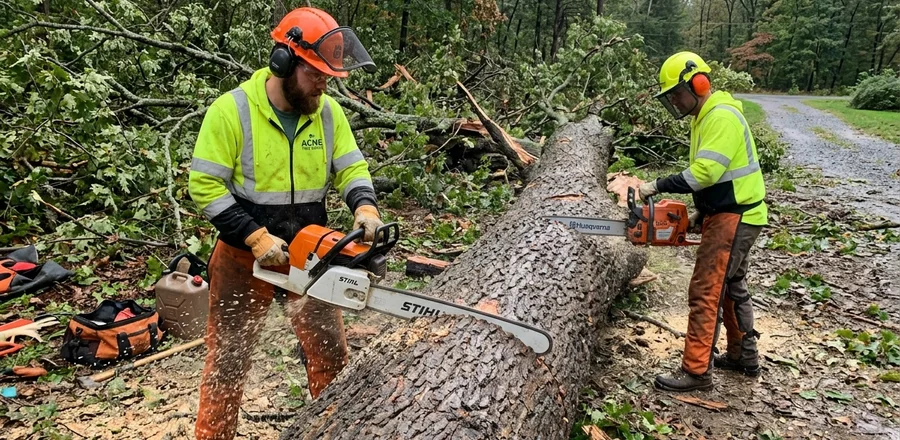
Every year as hurricane season opens in June and winter gale storms ramp up in autumn, coastal and inland property owners scramble to protect their homes from falling trees. However, well-intentioned homeowners frequently make disastrous mistakes—such as hiring unqualified handymen to "top" their trees, which actually dramatically increases storm failure risks. Professional storm preparation requires a science-based arborist approach that balances canopy aerodynamics, structural weight distribution, and root zone health.
"Tree topping" (lopping off the top of the main trunk and large canopy limbs to make the tree shorter) is considered malpractice under ANSI A300 arborist standards. Topping triggers rapid growth of weakly anchored "water sprouts" that snap off in moderate wind, starves the root system, and creates internal wood decay pockets. Topped trees are significantly more likely to collapse during hurricanes than properly pruned specimens.
1. The 4 Essential Steps of an Arborist Pre-Storm Audit
Crown Thinning (Reducing the Wind Sail Effect)
A dense, unpruned tree canopy acts like a solid wall against hurricane-force winds. Professional crown thinning selectively removes up to 15% to 20% of interior branches, allowing wind to pass smoothly through the canopy without transferring violent lateral torque to the trunk and root plate.
Roof & Structure Clearance Pruning
All limbs within 10 to 12 feet of your roofline, chimney, gutters, or solar panels should be pruned back to strong lateral branches. During high winds, heavy limbs flex downward by 6 to 10 feet, violently battering shingles and siding.
Hazardous Deadwood Removal ("Widowmakers")
Severed, dying, or rotten branches caught high in the canopy become lethal projectiles when 60+ mph wind gusts dislodge them. Pruning out dead limbs over 2 inches in diameter eliminates the primary source of residential property damage.
Root Flare & Soil Drainage Inspection
Over 80% of mature tree blowdowns during hurricanes are root plate failures caused by saturated soil. Ensure roof gutter downspouts do not dump water directly onto tree root flares, which softens soil and causes root unanchoring.
2. Pre-Storm Homeowner Checklist: 48 Hours Before Hurricane Landfall
- Document Pre-Storm Tree Health: Walk your yard with a smartphone and record video footage of all mature trees, demonstrating that they were living, green, and properly maintained. This provides undeniable proof if an insurance adjuster later attempts a "pre-existing rot neglect" denial.
- Clear Ground Debris & Firewood: Store outdoor furniture, loose firewood, and heavy tools inside garages so they do not become airborne missiles that damage tree bark or break windows.
- Identify Overhead Power Line Clearances: Locate where electrical service drops enter your home and take note of nearby limbs.
3. Post-Storm Triage: When to Call Emergency Dispatch
Once the storm passes, conduct a ground-level inspection from a safe distance. Call 24/7 emergency dispatch immediately if you observe:
- Fresh soil heaving or a raised root plate on one side of a leaning tree.
- Branches touching or entangled in electrical service wires.
- Cracked limb crotches that have not yet severed completely.
- Limbs resting directly against structural gutters, dormers, or roof shingles.
If severe weather has damaged trees on your property, call our 24/7 hotline at (855) 580-0754 for immediate connection with licensed crane and emergency tree crews.