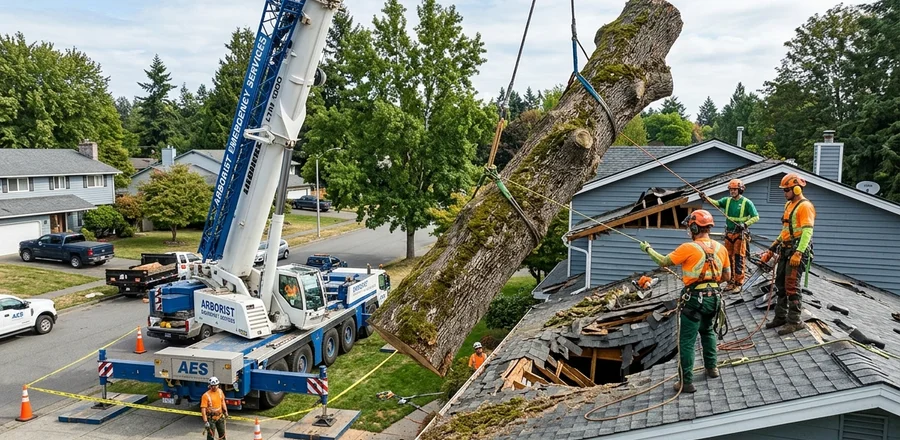
While summer hurricanes bring violent, short-duration wind gusts, winter ice storms represent an entirely different physical catastrophe for urban and suburban canopies. Unlike dry snow, which easily shakes loose in breezes, freezing rain coats every twig and branch in solid, crystalline glaze ice. Within hours, a peaceful winter storm can multiply the weight of a mature tree by up to 30 times, leading to catastrophic branch shearing, trunk shattering, and widespread power grid collapse.
1. Which Tree Species Survive Ice Storms (and Which Shatter)
Decades of research conducted by forestry universities across the Midwest, Northeast, and Southern ice corridors have categorized tree susceptibility to freezing rain:
| Vulnerability Level | Tree Species | Failure Reason |
|---|---|---|
| High Risk (Shatters) | Bradford Pear, Silver Maple, Siberian Elm, Green Ash, Willow | Brittle wood fibers, acute V-crotches, low wood tensile strength. |
| Moderate Risk | Loblolly Pine, White Pine, Red Oak, Hackberry, Birch | Evergreen needles retain massive ice surface; pines snap under heavy top loads. |
| Resistant (Survives) | White Oak, Bald Cypress, Ginkgo, Sweetgum, Hickory | Dense, flexible wood grain, excurrent central trunk growth, wide U-branch angles. |
2. Critical Winter Safety Rules for Homeowners
Never Shake Ice Off Frozen Branches
Under freezing temperatures, wood fibers become brittle like glass. Shaking, hitting, or poking branches with poles or brooms causes sudden transverse fractures, snapping limbs down onto your head or destabilizing the tree.
Beware of "Spring Poles" (Tensioned Branches)
Branches pinned to the ground under heavy ice or fallen trunks store massive mechanical tension. Attempting to cut an ice-laden branch with a chainsaw can cause it to violently whip upward, inflicting fatal blunt-force trauma.
Watch for Delayed Failures After the Thaw
Many trees do not collapse during the freezing rain itself, but 24 to 72 hours later as the ice melts. Melting ice causes uneven weight distribution, while warming wood fibers expand and release internal stress fractures.
3. Post-Ice Storm Tree Recovery Protocol
Do not assume a bent or damaged tree must be cut down immediately:
- Bent Young Trees: Young hardwoods bent nearly double under ice often spring back to an upright position once the ice melts. Give them several weeks to assess permanent lean.
- The 50% Canopy Survival Rule: If a mature tree has lost more than 50% of its main canopy branches, it will struggle to photosynthesize and enter terminal decline. Safe removal is typically the most prudent course.
- Clean Collar Pruning: Jagged, torn stubs where ice sheared branches must be cleanly pruned back to the branch bark collar by a professional arborist to prevent wood-boring fungi from infiltrating the trunk.