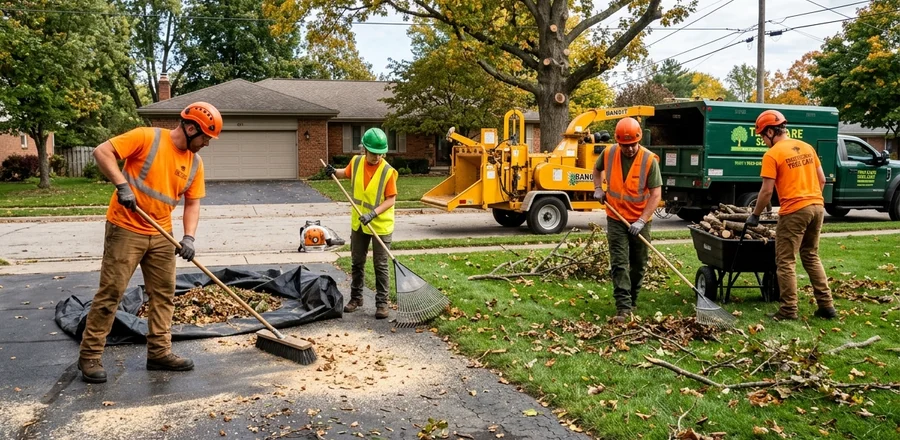
When storm winds topple a mature tree, the damage rarely stays confined to an open lawn. Frequently, trees crush shared property fences, flatten vehicles parked in driveways, or block essential access roads. In these multi-party scenarios, property owners face confusion over which insurance policy applies, whose deductible must be paid, and whether neighbors can be held liable. Here are the exact legal and insurance rules governing each scenario across all 50 states.
Scenario 1: Tree Crushes a Shared Boundary Fence
Fences positioned on shared property lines represent one of the most common post-storm neighbor disputes. Here is how insurance handles fence damage:
- Covered Under Coverage B (Other Structures): Standard homeowners policies cover detached structures—including fences, sheds, and detached carports—under Coverage B, which typically provides coverage equal to 10% of your dwelling limit.
- Shared Deductibles: If the fence is directly on the property boundary, both property owners technically share ownership. You and your neighbor can each file a claim with your respective carriers to split the repair cost, BUT each party must pay their own policy deductible (typically $500 to $1,500).
- The Deductible Reality Check: If replacing 30 feet of wood fence costs $1,800, and your deductible is $1,000, filing an insurance claim may yield only an $800 payout while risking future premium hikes. In many fence cases, neighbors choose to split the contractor bill 50/50 out-of-pocket without involving insurers.
Scenario 2: Tree Crushes a Car Parked in the Driveway
Homeowners are often shocked to discover that homeowners insurance does NOT cover damage to automobiles—even if your own tree collapsed on your own car in your own driveway!
Vehicle Damage is Paid by Auto Comprehensive Coverage
Physical damage to the car (dents, broken windshield, crushed roof) is covered strictly under your Auto Insurance Comprehensive (Other Than Collision) coverage, subject to your auto policy deductible (typically $250 to $500).
Who Pays to Remove the Tree Off the Car?
Removing the heavy tree trunk off the vehicle is typically split between policies. The auto insurer covers the cost to extract the tree from the car chassis, while the homeowners policy covers cutting and hauling the remaining wood from the driveway under the egress clause.
Scenario 3: Tree Blocks the Driveway or Access Road
What happens if a tree falls across your driveway, completely trapping your vehicles, but doesn't strike any building?
Under standard ISO HO-3 insurance policies, there is a specific "Emergency Egress Clause":
- Insurers WILL pay up to $500 to $1,000 for tree removal if a fallen tree prevents motor vehicles from entering or leaving a private residential driveway.
- The same coverage applies if the fallen tree blocks a wheelchair ramp or primary handicap accessibility walkway.
- If the tree fell across a public city road, the municipal Department of Public Works or County Road Maintenance is legally responsible for clearing the road for free.
Scenario 4: Tree Falls in an Open Lawn (Hits Nothing)
If a 60-foot pine collapses harmlessly across your grass, touches no building, and blocks no driveway, your homeowners insurance policy will pay $0. Insurers classify open lawn tree falls as routine landscaping maintenance.
If insurance will not pay, negotiate with the tree contractor to "buck the tree into firewood logs and leave on site" rather than hauling it away. Removing the woodchipper and dump trailer haul fees reduces your total contractor bill by 30% to 50%. You can then advertise free firewood on local community boards.
Summary: Who Pays Comparison Table
| Scenario | Responsible Policy | Typical Coverage Limit |
|---|---|---|
| Tree on Primary House Roof | Homeowners Coverage A (Dwelling) | Full Dwelling Limit (No sub-limit) |
| Tree on Detached Fence or Shed | Homeowners Coverage B (Other Structures) | 10% of Dwelling Limit |
| Tree on Car in Driveway | Auto Comprehensive Coverage | Actual Cash Value of Vehicle |
| Tree Blocking Driveway Only | Homeowners Debris Removal (Egress) | Capped at $500–$1,000 |
| Tree in Open Yard (Hit Nothing) | None (Homeowner Out-of-Pocket) | $0 Insurance Payout |