When severe thunderstorm downbursts, gale-force winds, or heavy winter ice storms cause a tree from a neighboring property to collapse across your roof, fence, or driveway, the immediate question every property owner asks is: who pays for the physical damage and emergency removal costs? Under standard U.S. property law and homeowners insurance regulations, legal liability depends heavily on whether the failure was an unpredictable natural event or the direct result of documented property negligence.
1. The General Rule: "Act of God" vs. Property Negligence
In common law jurisdictions across all 50 states, property owners are generally not held automatically liable for damage caused by natural forces. When a healthy tree or heavy limb is severed by extreme wind squalls or lightning strikes, insurance companies classify the event as an Act of God (Force Majeure).
In an Act of God scenario:
- Your Homeowners Policy Covers the Loss: Your own structural home insurance policy pays for roof repairs, living space restoration, emergency crane extractions, and property debris clearance up to your policy limits.
- Your Neighbor Pays Zero Out-of-Pocket: Because the failure was caused strictly by weather rather than human neglect, your neighbor cannot be forced to pay your deductible or repair bills unless negligence is proven.
2. When the Neighbor IS Legally Liable: Proving Negligence
A tree owner becomes fully liable for all structural damages, emergency tree removal invoices, personal injury claims, and your insurance deductible if you can prove legal negligence. Legally, every property owner owes a fundamental duty of care to inspect and maintain dead, diseased, or unstable trees on their land.
To establish neighbor liability in a storm damage claim, you must demonstrate the following three legal elements:
- Visible Pre-Existing Hazard: The tree exhibited clear external indicators of mortality or rot (such as hollow trunk cavities, fungal bracket conks, root shears, or missing foliage) prior to the storm.
- Notice & Awareness: The neighbor knew—or reasonably should have known—that the tree was structurally compromised and posed an active threat to your property.
- Failure to Mitigate: The neighbor failed to take reasonable actions (such as hiring an ISA Certified Arborist to prune, cable, or remove the dangerous tree) within a reasonable timeframe.
If a neighbor's dead or hollow tree leans toward your home, hire an arborist to conduct a visual risk assessment and send the written report to your neighbor via Certified Mail with Return Receipt Requested. This creates an irrefutable legal paper trail proving advance notice and establishing neighbor liability if the tree falls during a future storm.
3. Boundary Line Trimming Rights (Self-Help Law)
What can you legally do if a neighbor's healthy tree branches extend over your property line? Under the U.S. property legal doctrine of Self-Help:
- You May Trim Overhanging Branches: You have the legal right to trim branches and roots that physically cross your boundary line up to the exact property line border.
- Do Not Trespass: You cannot enter your neighbor's yard without explicit written permission.
- Do Not Kill or Unbalance the Tree: You cannot cut branches in a manner that destabilizes, kills, or structurally ruins the tree. If your aggressive pruning kills the neighbor's tree, you could be held liable for up to 3x the tree's replacement value under timber trespass laws.
4. Step-by-Step Action Plan When a Neighbor's Tree Crashes
Evacuate Hazardous Areas & Check Utilities
If the tree impact has compromised electrical wires or crushed roof joists, evacuate affected rooms immediately and contact emergency dispatch operators.
Capture Comprehensive Photo & Video Logs
Before any limbs are touched, photograph the tree resting on the structure, the point of trunk shear or uprooting, and interior ceiling damage from multiple angles.
Contact Your Homeowners Insurance Adjuster
Open a claim immediately. If you have evidence of neighbor negligence, provide your photos and certified warning letters to your adjuster so they can initiate subrogation against the neighbor's carrier.
Dispatch 24/7 Heavy Crane Rigging Crews
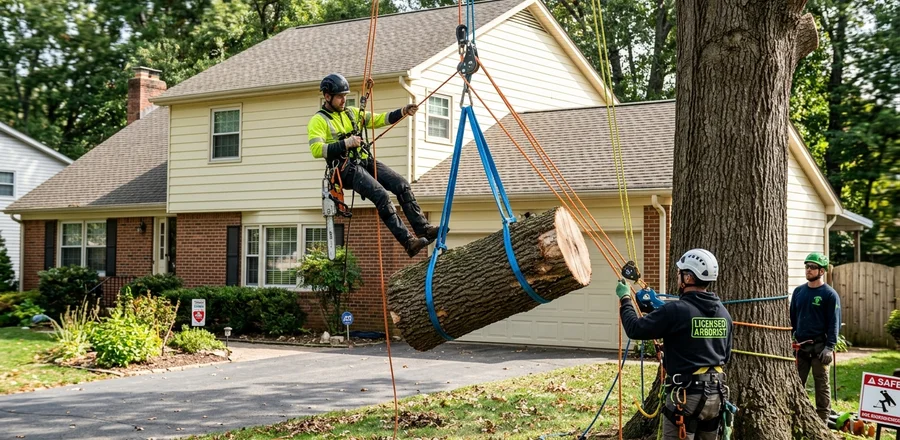
Hire an emergency tree service equipped with 100-ton all-terrain cranes to hoist heavy log sections vertically off your roof without secondary structure damage.
5. Insurance Subrogation: Getting Your Deductible Reimbursed
When your insurance company pays out your claim for a neighbor's fallen tree, they may initiate a process called subrogation. If your insurer successfully proves the neighbor was negligent, their insurance company will reimburse your insurer for the repair costs—and refund your out-of-pocket policy deductible (typically $1,000 to $2,500).